
You have studied grammar for years, but in front of the baker or the neighbour you switch to English without noticing. The good news is that the problem is not you: it is the study formula you chose. This guide compares the main options for Italian lessons in Italy — the city language school, the intensive course, private lessons and walking lessons on the Island of Elba — to help you choose the one that matches your goal, your time and your way of learning. It is written for motivated adults: those who own a house on Elba and want to talk with their neighbours, those preparing a trip who do not want to stay stuck in a classroom, those who need real conversation more than yet another set of rules to memorise. In between you will find a comparison table, six practical criteria and a concrete example of a choice. All written by Angela, a native Italian teacher from Elba with twenty years of experience teaching Italian to foreigners.
In short
- The right formula depends on your goal: those who want to hold real conversations need practical, tailored oral practice, not a generic course.
- The four formulas — city language school, intensive course, private lessons and walking lessons — serve different needs and should be chosen by criteria, not by price.
- To choose, just answer six questions about your goal, time, level and preferred context, and use them as the basis for asking for a personalised quote.
Who is looking for an Italian course in Italy and what they really want
Does this scene sound familiar? You are at the bar, the barman asks you something you did not expect, and for two seconds your mind goes blank. It is not a lack of study: it is that until now you have been translating, instead of speaking.
This guide compares the study formulas available in Italy and helps you choose the one that respects your goal and your time.
It is not the right path if you are looking for a certified qualification: in that case you need accredited courses. The author is Angela, a native Italian teacher born on the Island of Elba, with twenty years of experience teaching Italian to foreigners. To go deeper: keeping your Italian after the holiday.
The four formulas compared: city school, intensive, private, walking
Think about how you want to use Italian in three months, then look at the table: you will see which formula is closest to your case.
| Formula | How it works | Ideal for | Less suited to |
|---|---|---|---|
| City language school | Group classes with fixed timetables and a shared programme | Those who want structure and classmates | Those who fear groups |
| Intensive course | Many hours a week in a short time | Those with a short period and a precise goal | Those with little time every day |
| Private lessons | One teacher, programme built around goals and pace | Those who freeze up in conversation | Those looking for a social environment |
| Online lessons with a teacher | Individual remote lessons, agreed timetables | Those who cannot travel | Those who want to talk with real people and places |
| Free app or self-study | Independent exercises on the phone | Those who review vocabulary in spare moments | Those who need immediate corrections |
| Walking lessons on Elba | Individual lessons during walks | Those who combine study and holiday | Those who work at length on written texts |
How to choose: six practical criteria before booking
Before asking for a quote, answer six questions. The answers will tell you which formula makes sense for you, without comparing dozens of websites. Write the answers on a sheet of paper: they will also become the basis of the message you send to the school or the teacher.
- Goal: travel, work, everyday conversation or exam preparation? Write down the sentence you would like to be able to say in three months.
- Time available: how many hours a week can you really dedicate, and how long will you stay in Italy?
- Level and main fear: are you a beginner or intermediate? Is your block grammar or conversation?
- Group or individual: do you feel at ease in a class or do you prefer a tailored lesson with immediate corrections?
- Context: do you want a city, the sea, nature or the setting of your own home? A walking course needs a suitable place.
- Budget and inclusions: does the price cover materials, accommodation, outings or only the teaching hours? Ask for the list in writing before paying.
An example of a choice: two people, two different paths
A homeowner on Elba who wants to talk with the neighbour and the plumber finds a one-to-one lesson, done while walking or at the table, more useful. Someone who has to pass an exam in a few months, on the other hand, needs a structured course with assessments.
Ask yourself what you will need Italian for in the coming weeks: a person or a place points to a personalised path; a document or a deadline points to a certified course. To go deeper: walking lessons on Elba and table lessons. To go deeper: Italian lessons at the table.
How a walking lesson works, step by step
A walking lesson starts from a conversation, not from a book. Here is the sequence of each meeting with Angela.
- First meeting: define level, goals and interests.
- Choice of route: a slow stroll or a more dynamic itinerary.
- During the lesson: a conversation about impressions, comparisons and memories.
- After the meeting: note three expressions to reuse during the day.
How much it costs and how to ask for a quote
The cost of an Italian course in Italy varies a great deal depending on the formula chosen, so it is best to ask for a personalised quote rather than compare generic figures. Always ask for prices per precise hours, with the methods and duration stated.
- Formula: city school, intensive, private lessons or walking lessons have different costs and logic.
- Duration and frequency: the number of weekly hours and the total length of the course affect the price more than any other factor.
- Method: in-person, at-home or online lessons can come with different conditions.
- Accommodation: if the course is combined with a stay, check what is included and what is paid separately.
Online or in person: when each one makes sense
Choose online lessons if you cannot travel within Italy and want to study from your living room with flexible hours. Choose in-person lessons if you want to practise live conversation, with the noises, gestures and real pace of Italian life. The difference lies in the context you need.
Individual online lessons with Angela take place on a video platform, at agreed times. You lose no time on travel and can study even in the evening. For those with a few free minutes between two commitments, this format keeps the pace well.
At-home lessons, at the table or while walking, instead require you to be on Elba. They are useful when your goal is to talk with neighbours, craftspeople and shopkeepers. The place becomes part of the lesson, and the words come out of real situations.
| Criterion | Online lessons | In-person lessons |
|---|---|---|
| Travel | None: lesson from home | Needed: you reach Elba or the agreed place |
| Conversation | On screen, with some technical pauses | Live, with real context and noises |
| Ideal for | Those with little time and variable schedules | Those who want to talk with real people and places |
How to book the first lesson
To book, write to Angela stating your level of Italian, the goal you are interested in and the period when you would like to study. A few lines are enough: with this information Angela suggests the most suitable formula.
Before the first contact, prepare three things: a short description of how you speak today, the situations in which you would like to feel confident, and the dates or weeks available. There is no need to prepare a lesson: the first conversation is there to work out where to start.
If you want to know more about the way Angela works, you can read her method before writing. To go deeper: conversation in Italian in nature.
How to choose: six practical criteria with an example answer
Answer six questions: each answer rules out some formulas, and in the end one remains.
- Goal: «understand the menu and talk with the neighbour» rules out the exam course.
- Time: «two weeks on Elba in June» rules out the long intensive.
- Fear: «I freeze when I have to answer» rules out the app alone.
- Group or individual: «I don't want to speak in front of others» rules out the class.
- Context: «I want the sea and the trails» calls for a place suited to walking.
- Inclusions: «does the price include the hours and the materials?» should be clarified in writing.
How long a course lasts and how many hours are needed
A short, intensive path works for a trip with a precise goal, but leaves little room to consolidate. A path spread over several weeks lets you repeat and fix the words.
Ask for a duration based on the time you really have. You do not need a promise of fluency, you need a pace you can sustain.
The teacher
Unsure which path is right for you? Angela answers personally.
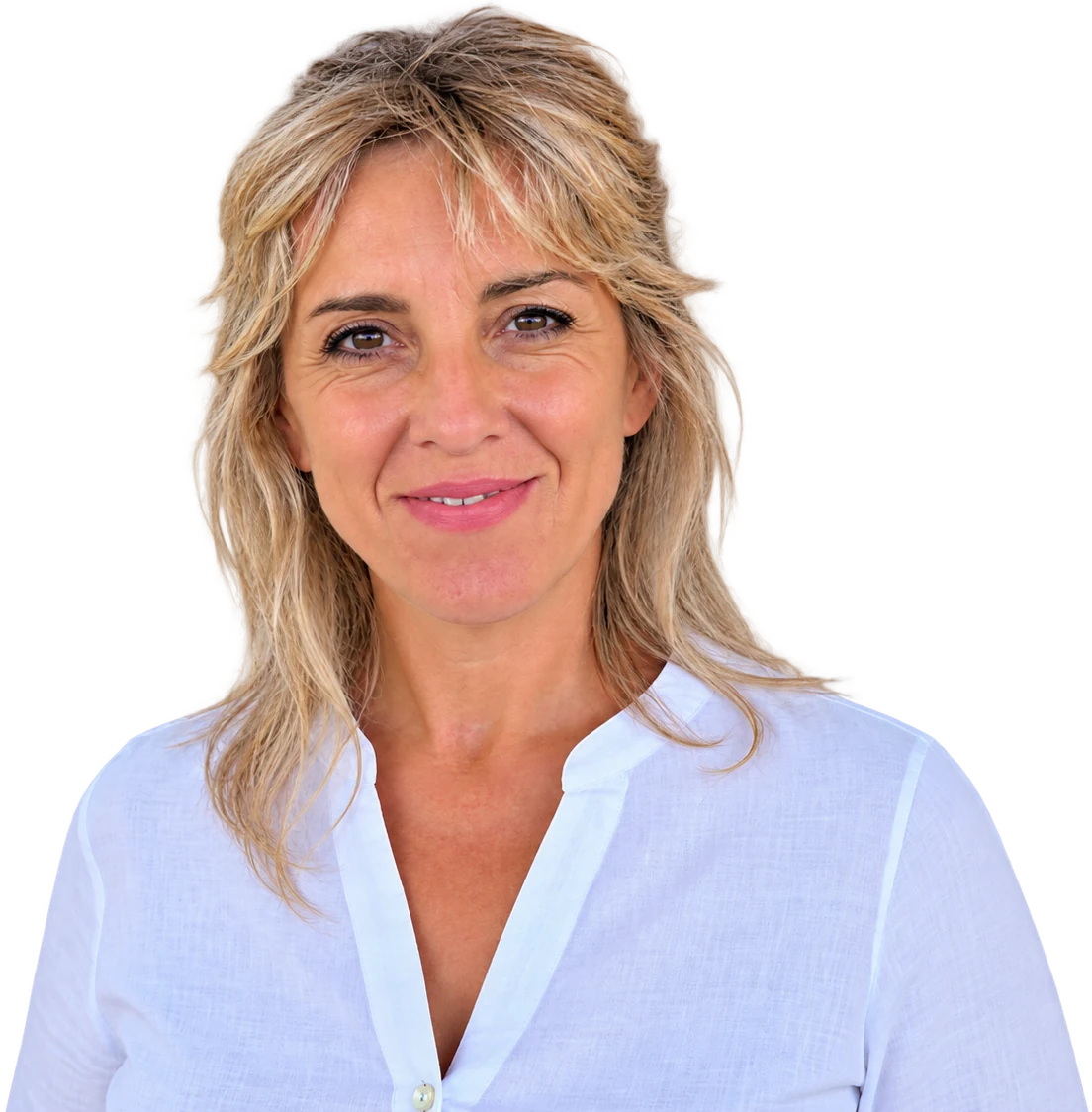
Angela Provenzali
Native Italian teacher on the Island of Elba
Born on Elba, she teaches Italian to foreigners with tailored lessons: walking, at the table, at home and online.
Frequently asked questions
How much time do I need to dedicate to study every day?
It depends on the formula: an intensive course requires many hours a day, while a tailored private lesson adapts to the time you really have. During a holiday, many people prefer a daily or alternate-day lesson combined with moments of free practice. Angela builds the path around the real time you can dedicate, without overloading you.
Can I learn Italian from absolute beginner level in Italy?
Yes, and indeed starting in Italy can be very motivating. The difference is made by the method: as a beginner you need a guided path, with a few useful words right away and plenty of oral practice, not lists of rules. Angela accepts absolute beginners and builds the first path starting from simple conversations linked to your everyday life.
Are outdoor lessons only for advanced learners?
No, this is one of the most common misconceptions. Walking reduces performance anxiety and also helps those who freeze up, because the conversation arises from what you see and experience. The level only serves to decide the words and topics of the path, not to decide whether you can start. Angela adapts every walk to the student's level.
What happens after the holiday, do I forget everything?
It is a legitimate fear, and the answer lies in maintenance: after the stay you can continue with individual online lessons at flexible times. Angela also offers specific guidance for keeping your Italian after the holiday, so you move from the big leap to consolidation without interruptions. Studying a little but regularly matters more than starting from scratch every year.
Can I bring my family and have lessons together?
Yes, there are lessons designed for families with adults and children, also separately when the levels are too different. This is useful during a stay: children work with a playful method, adults on practical conversation. When asking for a quote, indicate the number of people and their ages, so Angela can propose the right composition of lessons.
The right formula is not the most famous or the cheapest: it is the one that gets you speaking. If your goal is to hold real conversations in an authentic setting, tailored lessons — walking, at the table, at home or online — are the most consistent choice. The next step is simple: write to Angela a couple of lines about your level, your goal and the period you have available, and you will receive a concrete proposal for your first lesson.
Write to Angela a couple of lines about your level, your goal and your period: you will receive a tailored proposal for your first lesson.
Sources: https://italianoconangela.com/blog/sentieri-elba-lezione-italiano-all-aperto · https://italianoconangela.com/il-mio-metodo