
You're at the bar in Procchio, the barista asks you something and you answer in English. Again. It's not your age that stops you: you've never had ten minutes a day to devote to sentences you'd actually use. Here you'll find five short exercises to do tonight, with the written sentence and the solution, so that tomorrow you can answer in Italian.
In brief
- You can learn Italian as an adult starting from zero: method and consistency matter, not age.
- Short exercises on whole sentences work better than grammar studied in lists.
- When you understand but freeze when speaking aloud, exercises alone are no longer enough and an individual lesson is needed.
Is it possible to learn Italian as an adult starting from zero?
Yes, you can learn Italian as an adult starting from zero, if you choose short exercises and repeat them every day. Age matters less than concrete motivation and consistency.
Think of the Procchio market: tomorrow you'll say «Good morning, a kilo of tomatoes» and «How much does it cost?». Write them tonight and repeat them while you make your coffee. Use only sentences you will actually use.
Adults learn differently from children, not necessarily worse. Those who know why they want to speak Italian, for a home on Elba or to chat with the neighbours, keep up the pace.
If you're really starting from zero, see how a lesson for absolute beginners works on Elba. For more: Italian course for beginners on Elba. For more: seven tips for learning online. For more: how to keep your Italian after the holiday.
How long it takes and what it depends on
The time needed depends on three things: the goal you set yourself, the hours you can devote to it and how much real practice you manage to do. There is no guaranteed time to reach fluency, and anyone who promises precise dates should be treated with caution.
Twenty minutes a day of exercises and conversation often produce more progress than one isolated lesson a week, because language sticks through repetition. A weekly lesson remains useful for correcting mistakes. The two methods can be combined.
Take a stopwatch and test yourself: at the bar, order, ask whether they have brioche and answer one of the barista's questions. If you manage it in three minutes without switching to English, you have a clear sign that you're progressing. Repeat the test every two weeks, always in the same bar.
The exercise method: how to use them without getting bored
Short, repeated exercises work better than grammar-only study because memory fixes words when you use them inside a sentence, not when you read them in a list. Each exercise should therefore start from a whole sentence you could really say.
Think of a path: you don't walk all of it in one day, but one step at a time, returning to the same stretches until they become familiar. In the same way, repeat the same sentence in different situations, changing one element at a time.
A simple exercise to do today: write five sentences about yourself (where you live, what you eat, what you do in the morning), read them aloud and then rewrite them without looking. If this method doesn't suit you or you can't keep it up, a teacher can propose different exercises suited to how you learn.
Exercises for beginners: a five-step progression
If you've never studied Italian, you don't need to start with a textbook. Just follow five short steps, each built on the previous one, to do every day for about ten minutes. Each step asks you to produce something of your own, not just recognise the right answer.
- Step 1: recognise sounds and stress. Repeat aloud ten words such as «grazie», «buongiorno», «caffè», imitating the stress on the strong syllable. You're done when you say them all without looking.
- Step 2: introduce yourself with a four-line mini-dialogue: greeting, «Mi chiamo…», a question («E tu?»), a thank-you. Recite it three times aloud. You're done when you say it without reading.
- Step 3: questions and answers about an object. Choose your cup and form «Che cos'è?», «È una tazza.», «È blu?», «Sì, è blu.». Change object every day. You're done when you ask five questions in a row about the same object.
- Step 4: describe your routine with common verbs («mi alzo», «faccio colazione», «vado al lavoro», «torno a casa»), in time order. You're done when you tell your morning in six sentences without stopping.
- Step 5: ask for help in conversation. Learn «Non ho capito, può parlare più lentamente?» and use it whenever needed. You're done when you say it in a real conversation.
Ready-to-do exercises for today
These exercises are complete and solvable on this page: read the instruction, look at the worked example, then check against the solution. Do one exercise a day, for ten minutes.
- Definite articles. Instruction: choose il or la. Example: «___ caffè» → «il caffè». Solution: il caffè, la casa, il tavolo, la lezione.
- Present tense of regular verbs. Instruction: conjugate parlare with io, tu, lui. Example: io parlo, tu parli, lui parla. Solution: io parlo, tu parli, lui parla, noi parliamo.
- Passato prossimo with avere. Instruction: «Ieri ___ (mangiare) la pasta.» Example: ho mangiato. Solution: ho mangiato, hai mangiato, ha mangiato.
- Passato prossimo with essere. Instruction: «Ieri io ___ (andare) al mare.» Example: sono andato. Solution: sono andato (or andata), sei andato, è andato.
- Simple prepositions. Instruction: complete with a, di, in, da. Example: «Vado ___ Procchio.» Solution: vado a Procchio; sono di Roma; abito in Toscana; vengo da casa.
- Noun-adjective agreement. Instruction: «La casa è ___ (grande).» Example: grande stays the same in the feminine. Solution: la casa è grande; il tavolo è grande; la finestra è aperta.
- Plural. Instruction: write the plural of libro, casa, amico. Example: il libro → i libri. Solution: i libri, le case, gli amici.
- Phrases at the bar. Instruction: write how you order a coffee and how you pay. Example: «Un caffè, per favore.» Solution: «Quanto costa?», «Ecco, grazie», «Buona giornata».
- Ten conversation phrases at the bar. Instruction: say each phrase aloud, then reply with one of your own. Example: «Buongiorno, cosa prende?» → «Un cappuccino, grazie». Solution: use the model answers given above.
How to correct yourself: three quick checks
Without a teacher it's easy to repeat the same mistake for weeks. Three simple checks let you spot mistakes yourself, without any complicated tools.
- Record your voice while you read or tell a sentence of the day, then listen back. You'll immediately notice stretched vowels, shifted stress and pauses where they aren't needed.
- Compare what you said with a model sentence you wrote in the previous days. If the sentence is different, find the word that changed and note it in a notebook.
- Use this checklist on every written sentence: a subject present, the verb conjugated for the right person, the adjective agreeing with the noun, the article in front of the noun. If one of the four is missing, the sentence must be rewritten.
Table: exercises alone or with a teacher?
Self-study exercises are enough when you work on reading, vocabulary and writing simple sentences. They become insufficient when you freeze in a conversation or when you can't work out where you're going wrong, because in those cases you need someone who responds in real time.
| Situation | Exercises alone | Lesson with a teacher |
|---|---|---|
| Repeating short words and sentences | Suitable: just repeat aloud | Useful but not necessary |
| Freezing in a conversation | Insufficient: no interlocutor | Suitable: you practise dialogue |
| Understanding why you keep making the same mistake | Difficult: no correction | Suitable: the error is explained |
| Keeping a steady pace | Depends on personal discipline | Suitable: a fixed appointment |
When exercises aren't enough: the role of an individual lesson
If you do exercises alone and keep freezing when you have to answer aloud, the problem isn't grammar. You're missing someone who listens and corrects kindly. An individual lesson serves exactly this purpose: you speak, receive a correction at the right moment and pick the sentence back up without embarrassment.
The difference lies in the starting point. With a textbook you follow a fixed order, the same for everyone. With Angela you work from where you are: if you already know the greetings, you move straight to conversations about your day, your home or the trip you have in mind. The course is built together, with materials tied to your interests.
An individual lesson suits someone who has little time and wants to speak, not just read. If, however, you study Italian only to read texts or out of written curiosity, you don't need a guided conversation: written exercises and a dictionary may be enough for you.
To choose the format, you can start with lessons at the table in Angela's studio in Procchio, or with online lessons, with flexible hours from your home. Both follow the same criterion: your pace, your goals, direct correction. For more: Italian grammar without stress. For more: online Italian lessons.
Where to start: exercises by level
Choose the level that best describes your starting point. Each subsection has three exercises and a criterion for knowing when to move up to the next level.
First words and greetings
Here you work on the present tense, articles and greetings. Exercise 1: repeat «buongiorno», «buonasera», «arrivederci». Exercise 2: choose il or la before casa, tavolo, libro. Exercise 3: write your name in a sentence. You're ready for the next level when you recognise the greetings without looking.
Sentences in the present
Here you work on the present tense, prepositions, plural and agreement. Exercise 1: conjugate parlare and mangiare. Exercise 2: complete with a, di, in. Exercise 3: write the plural of ten nouns. You're ready when you build five present-tense sentences without agreement errors.
Telling stories in the past
Here you work on the passato prossimo and imperfetto, pronouns and reading comprehension. Exercise 1: conjugate mangiare in the passato prossimo. Exercise 2: rewrite a sentence in the past. Exercise 3: read a short text and answer three questions. You're ready when you tell about yesterday in five sentences.
The teacher
Not sure which path is right for you? Angela answers personally.
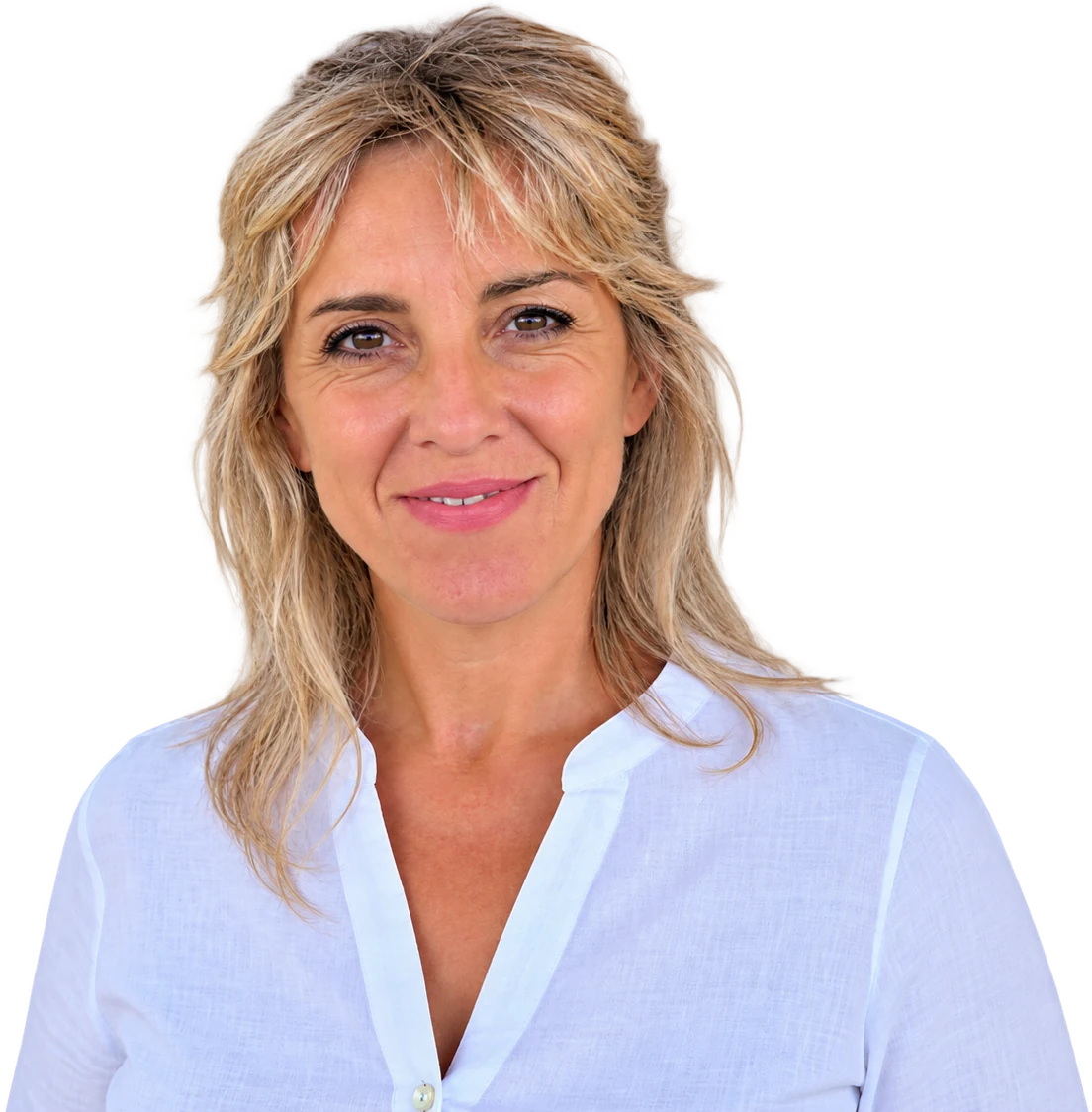
Angela Provenzali
Native Italian teacher on the Island of Elba
Born on Elba, she teaches Italian to foreigners with tailor-made lessons: on the move, at the table, at home and online.
Frequently asked questions
What are some simple books for learning Italian?
To start, rather than a classic textbook you need graded readers: books written specifically for beginners, with short sentences and a limited vocabulary, divided by level. Choose one with dialogues and audio, so you listen and read together. A novel or a newspaper in Italian, at this stage, will only risk discouraging you.
How can I learn Italian well?
You learn Italian well by combining three things: short daily exercises, plenty of listening practice and moments when you really speak with someone. Studying grammar alone isn't enough, because conversation requires retrieving the sentence in real time. If you can, alternate self-study with conversations with patient native speakers, even online once a week.
Do exercises work better in the morning or in the evening?
The best time is the one you can protect every day without effort: for many people it's ten minutes in the morning, before the day takes up their attention. Regularity matters more than the time of day. If instead you study for long sessions but only at weekends, slower progress is normal: better little and often.
Do I need grammar if I only want to speak?
You need minimal grammar: the words for people (io, tu, lui), verbs in the present and phrases for asking questions. The rest comes from speaking. Starting with complex tenses or written rules slows you down, because in real dialogue you have to produce simple sentences quickly, not analyse the language as at school.
Learning Italian as an adult starting from zero is possible: you need short exercises, whole sentences you can really say and a small weekly check so you don't consolidate mistakes. The five steps in this guide are your starting point; when you notice you understand but can't answer aloud, it's time for an individual lesson. Try the first step today, for ten minutes: write your first sentence and read it aloud.
If you find that exercises alone make you understand but not speak, try an [individual online lesson](https://italianoconangela.com/lezionionline): I listen, correct kindly and we build your course together.
Sources: https://italianoconangela.com/blog/lezioni-private-italiano-isola-d-elba · https://italianoconangela.com/il-mio-metodo · https://pubmed.ncbi.nlm.nih.gov/28743517/