
You're at the bar in Procchio and you answer in English? Italian lessons for beginner foreigners start from your real level: here's how the first lesson works, which format to choose and how to proceed week after week.
In short
- A personalized path starts from your real level and the situations in which you want to speak, not from a textbook that's the same for everyone.
- The first lesson as a complete beginner is a short, relaxed conversation, with no written tests: it's meant to figure out where to start.
- Choose the format, in cammino, at the table, at home or online, based on where you are, the time you have and how you learn best.
- If you need an official certification, a tailored conversation path won't replace it and it's best to make that clear right away.
Why generic courses don't work for those starting from zero
You're at the bar in Procchio, the neighbour asks you something and you answer in English. It's not your fault: no one has ever asked you in which situations you want to speak Italian. Textbooks explain grammar, but they don't prepare you for the phrase you really need.
Those who have taken a standard course for months repeat pre-packaged dialogues. When the baker asks how you want the bread, you can't find the words. In a group of ten you speak twice an hour; in a tailored lesson you speak for the whole hour. The first step isn't studying more: it's choosing a path that starts from your situation.
Who writes this guide: Angela, native teacher born on the Island of Elba, twenty years of experience in Italian for foreigners and a knowledge of the area that comes into the lessons when needed. To learn more: Italian course for beginners on Elba. To learn more: online Italian lessons. To learn more: Angela's method.
What a personalized path for beginners really means
Imagine having to ask where Procchio beach is: that phrase becomes the material of the first lesson. A personalized path starts from here, not from chapter one of a book that's the same for everyone.
Worked example. Situation: asking the way to the beach. Correct sentence: «Scusi, dov'è la spiaggia di Procchio?» (Excuse me, where is Procchio beach?). Typical beginner variant: «Scusi, dove è la spiaggia?». Angela corrects at the end of the sentence, explains that «dov'è» joins «dove» and «è», and makes you use the phrase again in another situation. At the next lesson she brings it back at the bar: if you say it without hesitating, that point is acquired.
- Concrete goals: together you decide what you want to be able to do, for example ordering at a restaurant or introducing yourself to a neighbour.
- Pace and timing: you choose how many times a week to meet and when to review, without a class schedule.
- Content taken from your days: vocabulary comes from shopping at the market and the phone calls you have to make.
- No imposed textbook: notes and activities created for you, as in the [personalized Italian lessons](/blog/lezioni-italiano-personalizzate-ritmo-individuale).
How the first lesson as a complete beginner works
The first lesson is not an exam: no one puts a written test in front of you. It's a short conversation in which you talk about your day, and from there you figure out together where to start. The standard duration of a lesson at the table is 2 hours per meeting.
- Initial conversation: you talk about yourself, your days and what you already understand, with no grades.
- Goals: you clarify why you want to learn, for example living on Elba or preparing for a trip.
- Format and first exercise: you choose among in cammino, at the table, at home or online and immediately do a first speaking practice.
- What to bring: a notebook or your phone for notes and the desire to speak even when making mistakes.
The first phrases you really learn (A1 level)
At level A1 of the Common European Framework of Reference for Languages (CEFR) you learn to introduce yourself, ask for simple information and handle a purchase at the bar. The descriptors of what you can do at A1 and A2 are in the official Council of Europe document[1]. There is no fixed date: it depends on the time you dedicate.
The order is tried and tested: alphabet and pronunciation, numbers and times, articles and gender, simple prepositions, c'è/ci sono (there is/there are), the verbs essere and avere (to be and to have). Here are the phrases that come up most often in the first week.
- Buongiorno, un caffè per favore. (Ordering at the bar)
- Di dove sei? / Sono di Milano. (Introducing yourself)
- Quanto costa? (Asking a price at the market)
- Dov'è la spiaggia? (Asking for directions)
- Non capisco, può ripetere, per favore? (Asking someone to repeat)
Mini-dialogue at the market
— Buongiorno, quanto costano le pesche? (Hello, how much are the peaches?) — Tre euro al chilo. (Three euros per kilo) — Ne prendo un chilo, grazie. (I'll take a kilo, thank you)
The minimal grammar to get started
Four points are enough for your first sentences. Example and typical mistake for each.
- Articles and gender: «il mercato è aperto» (the market is open). Typical mistake: «la problema» (problema is masculine).
- Essere and avere: «ho fame, sono stanco» (I'm hungry, I'm tired). Typical mistake: «io sono fame», modelled on the English I am hungry.
- C'è or ci sono: «c'è una spiaggia, ci sono due bar» (there's a beach, there are two bars). Typical mistake: «è una spiaggia».
- Prepositions of place: «la spiaggia è vicino al porto» (the beach is near the port). Typical mistake: using «a» everywhere, modelled on at.
Exercises to try right away
Three self-correcting exercises written by Angela, to do even before the first lesson. Write to Angela to receive the PDF worksheet.
- Complete with essere or avere: «Io ___ fame», «Tu ___ di Londra», «Il caffè ___ buono». Solutions: ho / sei / è.
- Choose the article: ___ pesca, ___ pane, ___ acqua. Solutions: la / il / l'.
- Put the mini-dialogue at the bar in order: «Sono due euro» / «Un caffè, per favore» / «Buongiorno, cosa desidera?». Order: 3, 2, 1.
Which format to choose: in cammino, at the table, at home or online
Choose the format based on where you are, how much time you have and how you learn best. In cammino means speaking while exploring Elba; online if you're far away and have variable schedules.
The lessons [at the table](/lezionialtavolo) take place in Angela's study or garden in Procchio. The lessons [at home](/lezioniadomicilio) reach your accommodation on the island. The [online lessons](/lezionionline) are individual, via video platform, with flexible schedules. How the in cammino lessons work you can find on the [dedicated page](/italianoincammino). To learn more: in cammino lessons on the Island of Elba.
- In cammino: outdoor conversation on trails and in villages; for those who don't want to be stuck in a classroom.
- At the table: full concentration and dedicated materials; for those who want more structured lessons.
- At home: no travel, work in your accommodation; for those with a full day.
- Online: from anywhere, flexible schedules; for those studying from home or preparing a trip.
| Format | Where it takes place | When to choose it | Duration and indicative cost |
|---|---|---|---|
| In cammino | Trails and villages of Elba | You want to speak outdoors during your holiday | Variable depending on the route; ask Angela |
| At the table | Angela's study or garden in Procchio | You prefer a quiet, well-equipped place | 2 hours per meeting; ask for the current cost |
| At home | Your accommodation on the island | You have little time to travel | 60 euros per hour, no travel fee for meetings of at least two hours |
| Online | From your home, via video platform | You're far away or have variable schedules | 50 euros per hour, flexible schedules |
An example of a path in the first weeks
The path evolves week by week, starting from your real level, with a check-in every week.
- Week 1: introducing yourself, asking someone's name and saying where you're from, you try ordering at the bar in Procchio.
- Week 2: numbers, prices and articles, used at the market fruit stall: you ask the cost and understand the answer.
- Week 3: directions and places with c'è/ci sono and prepositions, you try asking where the beach is.
- Weekly check-in: together you check what you can say without hesitating and the program changes accordingly.
How to tell if you're making progress
Progress shows when a situation that used to block you becomes manageable. Here are the signals to watch every week, the same ones used in the check-in: if you hesitate on a phrase, Angela brings it back in the next lesson with a different situation.
- You can order without mentally translating the sentence from English.
- You understand the neighbour's question even when they speak a bit fast.
- You answer without switching to English, even with simple sentences and a few pauses.
- You remember the correct phrase after a week, without reviewing it.
When a personalized course isn't the right choice
A tailored path isn't always the right answer. If you need a recognized official certification, a university course or a cheaper group program, another school may be more suitable. Angela doesn't replace a certified course.
Those who need to pass an official exam need a structured program modelled on the test, with fixed dates. An individual course can complement it, but rarely replaces it on its own.
Those who don't yet know why they want to learn find a manual with ordered chapters more useful. A personalized path requires you to say what you want to do with the language, for example talking with a craftsman.
The next step: talking with Angela about your goal
Imagine being on holiday on Elba, in the morning over a coffee, and finally wanting to answer the neighbour without searching for the word in English. The first step is simple: write to Angela and describe your concrete goal. You don't need to prepare a perfect program; a few lines telling where you are and what you want to be able to do are enough.
An effective message can contain three pieces of information: your current level, your goal and the format you prefer. For example: «Sono principiante, vorrei sostenere una breve conversazione al mercato, posso studiare due volte a settimana, preferirei in cammino.» (I'm a beginner, I'd like to hold a short conversation at the market, I can study twice a week, I'd prefer in cammino.) With these words Angela can offer you a path built on your real situation, not a generic course.
If you don't yet know which format to choose, you can indicate several options. The in cammino lessons let you learn while exploring trails and villages; the lessons at the table offer a quiet space for grammar; the online lessons give scheduling flexibility from anywhere. Each format makes sense differently depending on your day and your goals.
This approach isn't suitable for those looking for an intensive program already defined in detail or a certification with a close deadline: in these cases it's best to make it clear right away, because the path changes a lot. Even those who just want to review one phrase may find a single trial lesson sufficient.
When you write, also indicate your weekly availability and whether other people would take part. A family with a beginner child and a more advanced adult, for example, requires a different setup than an individual lesson. To learn more: personalized lessons and individual pace.
The teacher
Unsure which path is right for you? Angela answers personally.
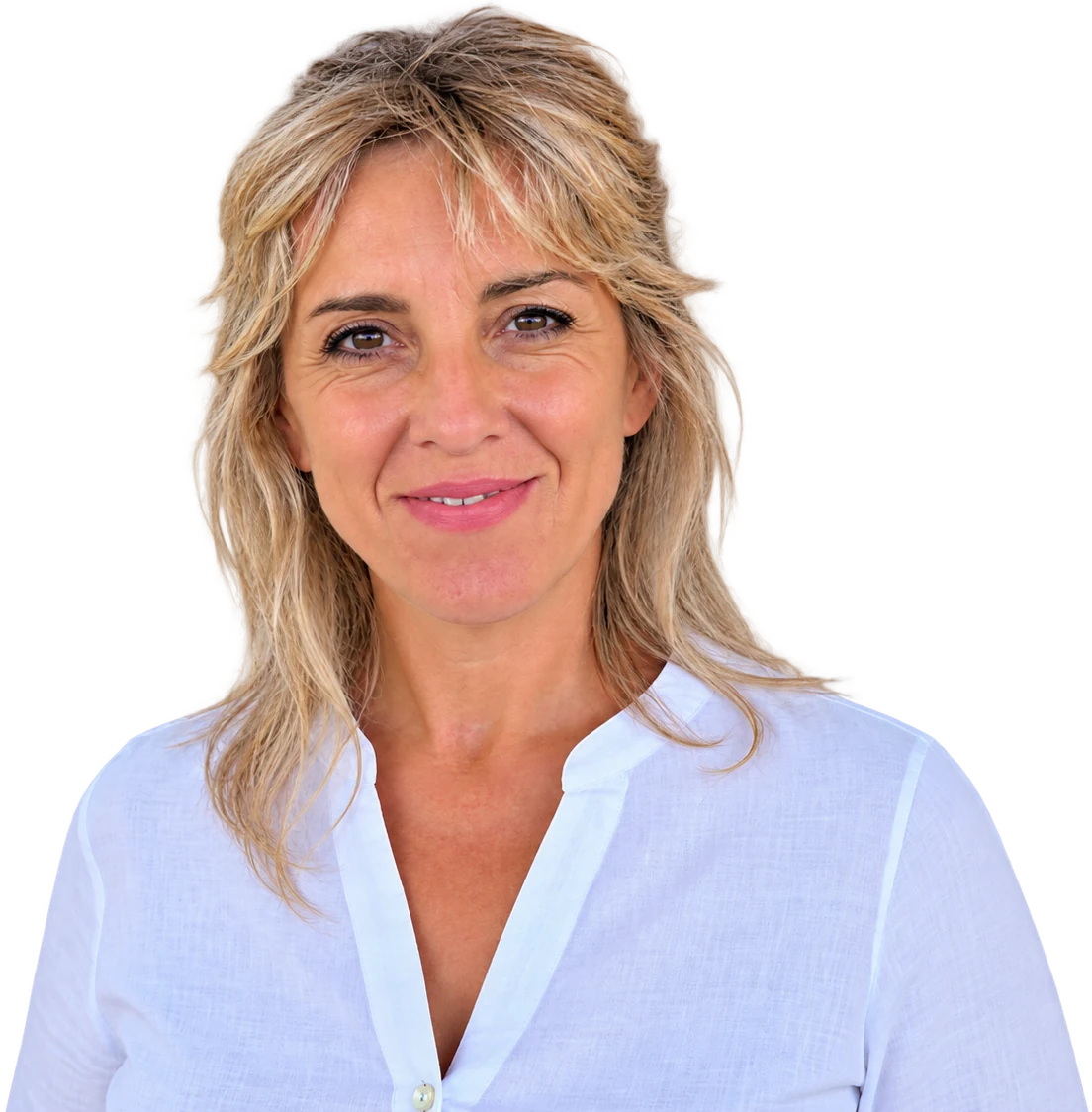
Angela Provenzali
Native Italian teacher on the Island of Elba
Born on Elba, she teaches Italian to foreigners with tailored lessons: in cammino, at the table, at home and online.
Frequently asked questions
What level is a complete beginner?
A complete beginner doesn't yet know the language or knows very few words. Level A1 of the CEFR describes what you can do: introduce yourself, ask for simple information and handle a purchase at the bar.
Better an app, a group course or a teacher to start?
An app helps you get familiar with sounds and words, but doesn't make you speak with someone who corrects you. A group course costs less but leaves little space for each person. An individual teacher is the most suitable choice if you want to speak from the very start.
How many words do you need to get by on holiday?
For the most common situations a few dozen phrases are enough: ordering, asking the price, asking for directions and introducing yourself. It's best to learn them in context, not by heart, because you'll really use them.
Learning Italian from scratch doesn't depend on how many books you leaf through, but on a path that starts from you: first a conversation to understand where to begin, then small goals checked every week, in the format that suits you best. The next step is simple: write Angela two lines about who you are and what you'd like to be able to say in Italian. From there you'll build the first lesson together.
Write Angela two lines about your goal, whether it's a trip to Italy or a house on Elba: she'll reply with a proposal for a tailored first lesson.
Sources
- Istat — istat.it. Consult the source